
 Salih Karadeniz
How a Spanish stock image company pivoted to become a full-stack AI creative platform
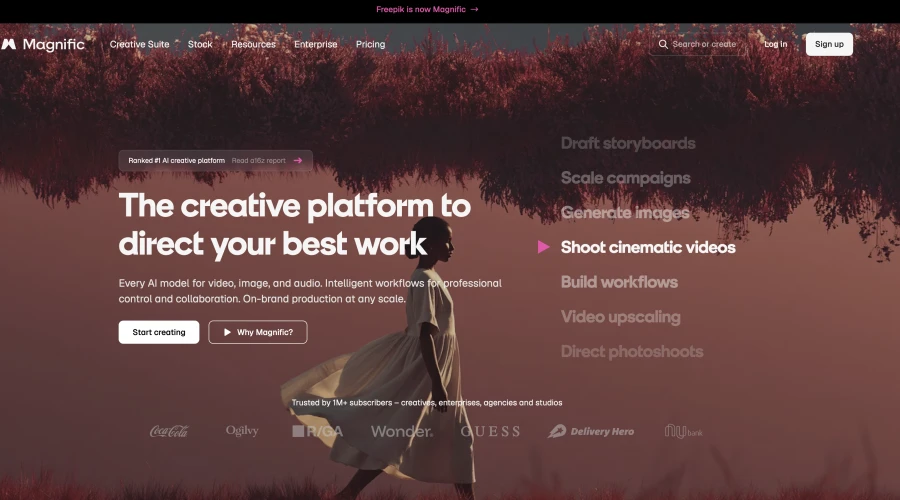
Freepik—the Málaga-based graphic resources platform founded in 2010—officially rebranded as Magnific. This is not merely a cosmetic name change. It represents the culmination of a strategic transformation that began with the acquisition of the AI upscaling tool Magnific in May 2024 and has now evolved into a unified, full-stack AI creative platform. With over 1 million paying subscribers, $230 million in annual recurring revenue (ARR), and more than 250 enterprise clients including BBC, Puma, and Delivery Hero, the newly christened Magnific is positioning itself as Europe’s answer to American AI giants .
The Strategic Context: Why Rebrand Now?
For sixteen years, Freepik built a global audience as a search engine for graphic resources—vectors, photos, icons, and templates. But the generative AI revolution fundamentally altered the creative landscape. Users began shifting from downloading assets to generating them instantly. The company faced a classic innovator’s dilemma: remain a stock library or reinvent itself as an AI-first creation platform .
CEO Joaquín Cuenca Abela acknowledged the perception problem: "People saw fragments: Freepik as a stock image bank, Magnific as an upscaler. This is the first time the complete system is visible as what it has been for years: a single platform" .
The rebrand consolidates a fragmented portfolio into a coherent identity. Previously, the company operated under multiple names: Freepik for stock assets, Magnific for AI upscaling, and various other tools under separate branding. Now, everything lives under one roof at magnific.com.
The Backstory: An Acquisition That Changed Everything
The seeds of this transformation were planted in May 2024, when Freepik acquired Magnific, a Murcia-based startup founded by Javi López and Emilio Nicolás . Launched just five months earlier, Magnific had achieved remarkable traction:
-
30,000 users within 24 hours of launch
-
725,000 users with zero paid marketing
-
Created an entirely new product category: "reimagined upscaling"
The acquisition brought the founders into Freepik's AI innovation team, where they helped accelerate the development of generative capabilities across image, video, and audio . By late 2025, Magnific Precision v2 had launched—featuring three specialized AI models (Sublime, Photo, and Photo Denoiser) for different upscaling needs, demonstrating how deeply the technology had been integrated .
What began as a best-of-breed upscaling tool has now become the flagship brand for an entire creative ecosystem.
What Magnific Is Today
The unified platform offers capabilities that, according to Cuenca, no direct competitor—not Midjourney, not Runway, not Leonardo—currently matches under a single roof :
| Capability | Description |
|---|---|
| AI Image & Video Generation | Multiple models, including 4K output with audio |
| AI Upscaling | The industry-leading technology that started it all, now with precision control |
| Real-time Collaborative Workspace | Node-based canvas called "Spaces" for team workflows |
| 3D & Virtual Scene Tools | Exclusive tools for 3D creation |
| 250M+ Asset Library | Full stock library (photos, vectors, icons, templates, fonts) with commercial AI license |
| AI Audio Tools | Sound generation and editing |
| Model-Agnostic Architecture | Integrates third-party models from Google, ByteDance, and others |
The platform processes 4 million images per day and serves a community that has grown from Freepik's 65 million active users plus Magnific's 700,000 professionals .
The "No-Collar" Economy: A New Labor Thesis
Beyond the product, the rebrand introduces a bold conceptual framework. Cuenca has been developing what he calls the "No-Collar" economy—a labor market transformation he believes is comparable in scale to the Industrial Revolution (which created blue-collar jobs) and the Digital Revolution (which created white-collar jobs) .
"Creative professionals are about to become more powerful than anyone expected," Cuenca argues. "That's the no-collar economy. People who don't wear a shirt collar. And it's already underway."
The thesis rests on a fundamental observation: 72% of new creators joining the platform identify as beginners . This suggests a structural shift in who can produce professional-quality creative work. The cost and complexity barriers that once required studios, crews, and significant capital are rapidly collapsing.
"In the future, we will make movies the same way we write books," Cuenca told Euronews. "One person with a vision and the tools to execute it" .
This is not theoretical. Productions like The Chronicles of Bone (a viral dark fantasy series with millions of views) and The Patchwright (an AI-native sci-fi production) were created on the platform by individual filmmakers or small teams .
Enterprise Adoption: From Experimentation to Production
Perhaps the most telling validation comes from enterprise adoption. Magnific's Business plan—launched in January 2026 for smaller teams—surpassed 2,000 subscriptions in six weeks and continues growing at 150 new teams per week .
Enterprise clients are no longer experimenting; they are building production workflows:
| Client | Use Case |
|---|---|
| BBC | Content production at scale |
| Puma x Manchester City | Hybrid 3D + AI campaign by The Berry |
| Delivery Hero | Global content creation |
| Amazon Prime Video | House of David production used AI for cinematic scenes |
| Alain Afflelou | TV ad campaign integrating products into animated characters |
Nick Coronges, CTO at R/GA, stated: "Best-in-class models and workflow tools through a single unified interface. Magnific has been a key unlock as we've woven AI into our workflows, end to end" .
The European Anomaly: Bootstrapped to $230M
What makes Magnific's trajectory remarkable is its financial independence. Unlike most AI companies that rely heavily on American venture capital, Magnific has never raised a single round of VC funding . The company is profitable, bootstrapped, and generated $230 million in ARR organically.
"We started with zero capital: three friends dreaming big," Cuenca reflected. "We didn't know what we were going to build. We only knew we weren't comfortable standing still. We found new things to create. Now we'll find new stories to tell" .
This bootstrapped model has strategic advantages. Magnific is not subject to VC-driven growth pressures or exit timelines. Andreessen Horowitz recently named it the #1 generative AI web company in Europe by users, placing it in direct competition with US-based platforms despite its lack of massive capital .
What Changes for Existing Users?
The rebrand raises practical questions for the existing user base. According to Magnific's official FAQ:
-
Freepik is now Magnific. Same team, same technology, redesigned as a full AI creative platform.
-
The upscaler remains at magnific.ai with no disruption to existing subscriptions. Plans run until they expire.
-
Both stock library and AI tools coexist. Magnific brings together the full 250M+ stock library alongside the complete AI creative suite.
-
Nothing changes regarding plan, price, billing cycle, or payment method.
-
Users own everything they generate. Magnific never trains on user data, and all content comes with a full commercial AI license.
The transition appears designed to be seamless for existing subscribers while signaling a new strategic direction to the market.
Competitive Positioning: The Full-Stack Advantage
The creative AI landscape is crowded with specialized players:
-
Midjourney: Image generation only
-
Runway: Video/AI tools, no stock library
-
Leonardo: Image generation, limited stock
-
Adobe Firefly: Integrated but proprietary, enterprise-focused
Magnific's claimed differentiator is breadth: image generation, video generation, upscaling, audio, 3D, collaborative workflows, and a 250M-asset stock library—all under one platform, all accessible via a single API with pay-as-you-go pricing .
The model-agnostic approach is particularly strategic. Rather than forcing users into proprietary models, Magnific acts as an orchestration layer, allowing teams to access multiple AI models (including competitors' through integration) from a single interface. This reduces vendor lock-in and gives enterprise clients flexibility.
Challenges and Risks
Despite the strong positioning, Magnific faces significant challenges:
1. Brand Awareness Transition
Freepik has brand equity built over sixteen years. Rebranding to Magnific risks confusing existing users. The company's FAQ section and blog posts suggest they are aware of this and proactively communicating the change.
2. Competition from Giants
Adobe, Canva, and established players are rapidly integrating AI. While Magnific has a first-mover advantage in unified full-stack offerings, the incumbents have distribution and deep enterprise relationships.
3. The "No-Collar" Thesis Is Unproven
The claim that 72% of new users are "beginners" could indicate democratization—or it could indicate that professionals are not adopting the platform at the same rate. Enterprise adoption will be the true test.
4. Regulatory Scrutiny
As a European AI company, Magnific must navigate the EU AI Act, which imposes compliance burdens that American competitors may not face. However, being European could also become a competitive advantage for clients prioritizing GDPR compliance and data sovereignty.
A Defining Moment for European AI
The transition from Freepik to Magnific is more than a rebrand. It represents a strategic bet that the future of creative work is not about accessing content libraries but about generating content instantly, collaboratively, and at scale—all within a single platform.
Magnific's path is unusual: bootstrapped to $230 million ARR, European-based, and competing directly with well-funded American AI companies. Whether the "No-Collar" thesis proves correct will depend on execution, but the early indicators—1 million subscribers, 250 enterprise clients, and productions like The Chronicles of Bone—suggest momentum.